Artists
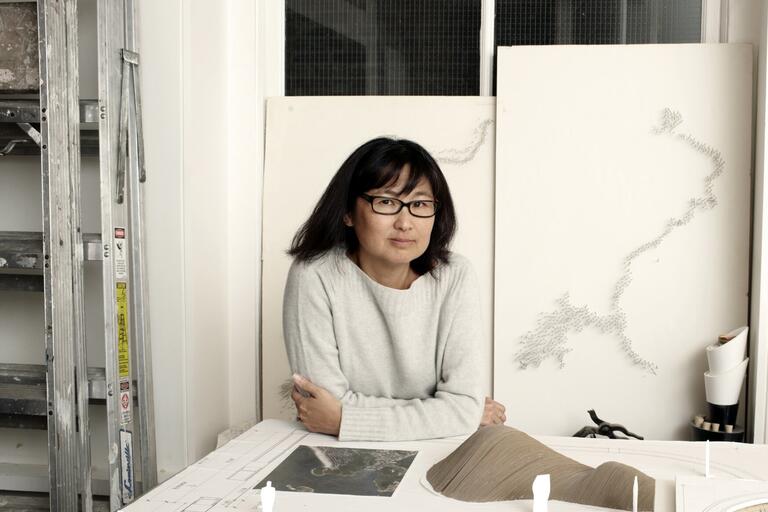
Maya Lin
Athens, OH, United States, b. 1959
Maya Lin is an artist, architect, and designer whose multidisciplinary practice spans memorials, architecture, and large-scale environmental installations. She is internationally recognized for creating spaces of memory and reflection, as well as works that heighten awareness of the natural world and humanity’s impact upon it. Her art and architecture exist “between boundaries,” as she has written, uniting opposites—science and art, East and West, art and architecture—while asking viewers to reconsider their surroundings.
Lin was thrust into public prominence while still an undergraduate at Yale University, when her design for the Vietnam Veterans Memorial (1982) in Washington, D.C. was selected through national competition. She went on to design the Civil Rights Memorial in Montgomery, Alabama (1989), the Langston Hughes Library in Clinton, Tennessee (1999), and numerous other significant public and private projects. In 2009 she began What is Missing?, her final memorial, a global, multimedia project addressing biodiversity and climate change.
Her art—often inspired by topographies, water, and natural systems—has been exhibited widely and is held in the collections of the National Gallery of Art, the Metropolitan Museum of Art, the Museum of Modern Art, the Smithsonian Institution, and the Nelson-Atkins Museum of Art, among others. She is represented by Pace Gallery, New York.
The recipient of the National Medal of Arts (2009) and the Presidential Medal of Freedom (2016), Lin is a member of the American Academy of Arts and Letters and the American Academy of Arts and Sciences. Her life and work were the subject of the Academy Award–winning documentary Maya Lin: A Strong Clear Vision (1994).