The Collection

Beverly Buchanan
Untitled
Beverly Buchanan was an American artist whose wide-ranging practice—spanning sculpture, painting, drawing, video, and land art—explored Southern vernacular architecture, memory, and the resilience of Black communities in the American South. Born in Fuquay, North Carolina, and raised primarily in Orangeburg, South Carolina, Buchanan spent much of her childhood accompanying her adoptive father, Walter Buchanan, Dean of the School of Agriculture at South Carolina State College, on visits to tenant farmers throughout the Cotton Belt. These early encounters with local architecture, subsistence practices, and rural landscapes profoundly shaped her lifelong engagement with place and materiality.
Buchanan initially pursued a scientific career, earning a BS in medical technology from Bennett College in 1962, followed by an MS in parasitology (1968) and an MPH (1969) from Columbia University. She worked as a medical technologist and public health educator in New York and New Jersey before deciding to shift fully toward the arts. In 1971, she enrolled at the Art Students League in New York, where she studied with Norman Lewis and received significant mentorship from both Lewis and Romare Bearden. Their influence, along with her own memories of Southern architecture and community life, guided her transition to full-time artistic practice.
Buchanan first gained recognition in the 1970s for her abstract expressionist paintings and early sculptural works, including her “Wall” series exhibited at the Montclair Art Museum in 1976. After moving to Macon, Georgia, in 1977, she began creating site-specific concrete sculptures installed directly in the landscape. Major works such as Ruins and Rituals (1979) and Marsh Ruins (1980), the latter produced through a Guggenheim Fellowship, explored themes of ruination, commemoration, and the histories of Black communities in the South. Many of these works were intentionally left to decay, integrating natural processes into the conceptual framework of the pieces.
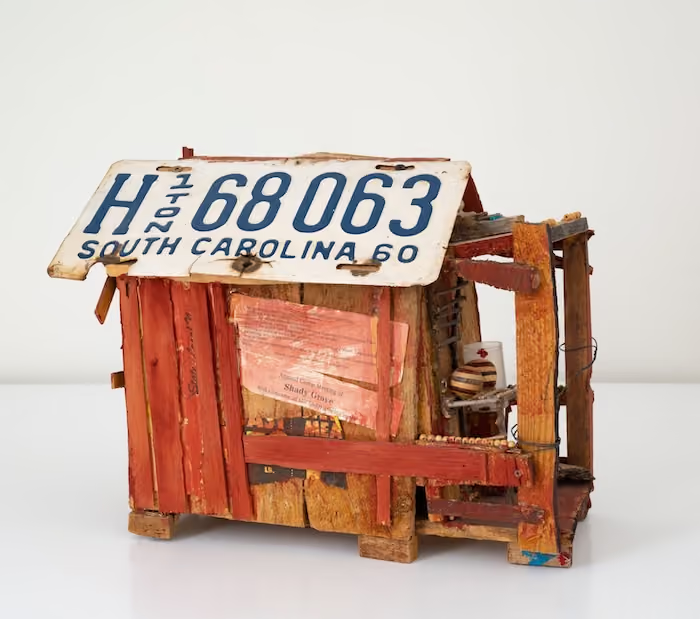
In the mid-1980s, Buchanan developed what would become her most celebrated body of work: sculptural “shacks” inspired by the improvised, self-built dwellings of rural African American communities. Constructed from humble materials and accompanied by hand-written or typed “legends,” these assemblages blended memory, narrative, and vernacular architecture to evoke endurance, care, and the lived histories of ordinary people. Her later works—oil pastel flower drawings, small assemblages, and folk-inspired sculptures—continued to reflect her deep connection to Southern landscapes and the creativity found in everyday environments.
Over the course of her career, Buchanan received major honors, including a Guggenheim Fellowship, a National Endowment for the Arts Fellowship, and the Anonymous Was A Woman Award. Her work has been featured in exhibitions at the Studio Museum in Harlem, the African American Museum in Dallas, and numerous institutions across the United States. Her art is held in the collections of the Metropolitan Museum of Art, the Whitney Museum of American Art, the Studio Museum in Harlem, the High Museum of Art, and others. In 2016–17, the Brooklyn Museum organized a significant posthumous retrospective, Beverly Buchanan—Ruins and Rituals, reaffirming her influential role in American art and her profound contributions to the visual history of the South.