The Collection
Radcliffe Bailey
Stride
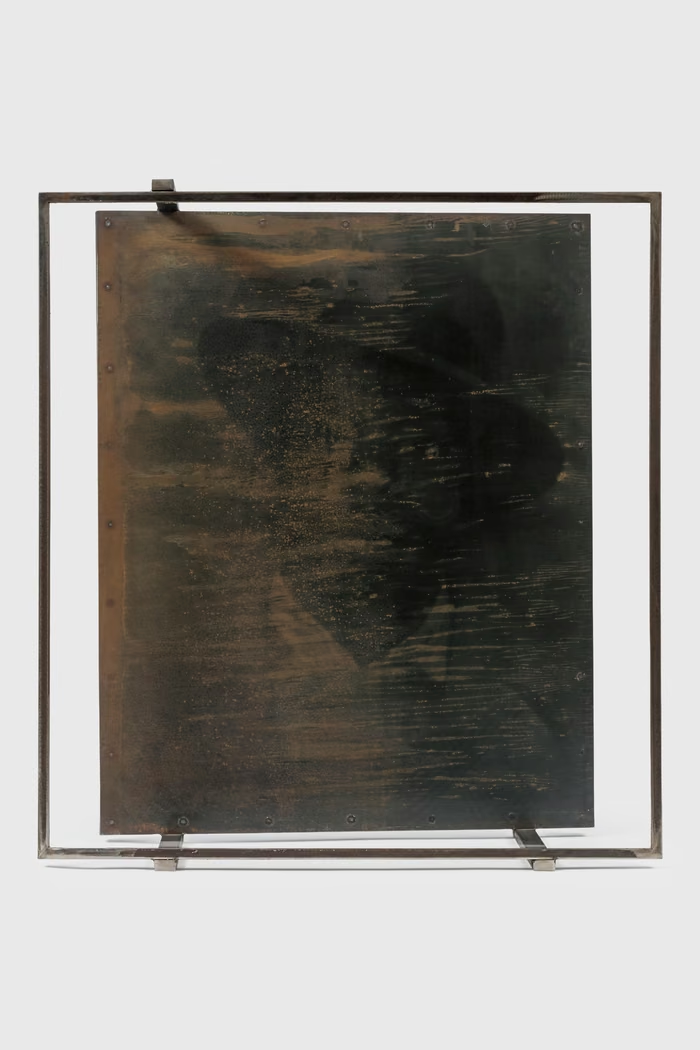
Radcliffe Bailey was a painter, sculptor, and mixed-media artist whose work explored ancestry, race, migration, memory, and the African diasporic experience. Known for his layered compositions that brought together imagery, text, and culturally resonant materials, Bailey created works that were at once deeply personal and universally resonant. His practice frequently incorporated found objects such as tintype photographs of family members, traditional African sculpture, train tracks, ships, and Georgia red clay, weaving together personal history with collective memory.
Music was also a vital influence, shaping the rhythm and resonance of his work. One of his most iconic pieces, Windward Coast (2009), comprised hundreds of discarded piano keys arranged in undulating waves, evoking both the turbulent waters of the Middle Passage and the cultural continuity carried through song. Bailey often described his art as an effort to honor his family and to reframe history as inclusive rather than exclusive: “I believe that by making things that are very personal they become universal.”
Born in Bridgeton, New Jersey, Bailey grew up in Atlanta, where his mother introduced him to the work of artists such as James Van Der Zee and Jacob Lawrence at the High Museum of Art. He earned his BFA from the Atlanta College of Art in 1991. Early on, he assisted sculptor Melvin Edwards, an experience that further anchored his interest in monumentality and materials. Over his career, Bailey’s work was presented in major solo exhibitions, including Memory as Medicine (High Museum of Art, Atlanta, 2011), and featured in countless group exhibitions across the United States and abroad.
Bailey’s art is represented in many significant public collections, including the Metropolitan Museum of Art (New York), the Art Institute of Chicago, the Smithsonian American Art Museum (Washington, D.C.), the Museum of Fine Arts (Houston), the High Museum of Art (Atlanta), and the Nelson-Atkins Museum of Art (Kansas City).
Through his unique merging of sculpture, painting, and assemblage, Bailey created a body of work that excavated the complexities of history and identity, placing African American experience at the center of contemporary art and leaving a lasting influence on future generations.