The Collection
Kerry James Marshall
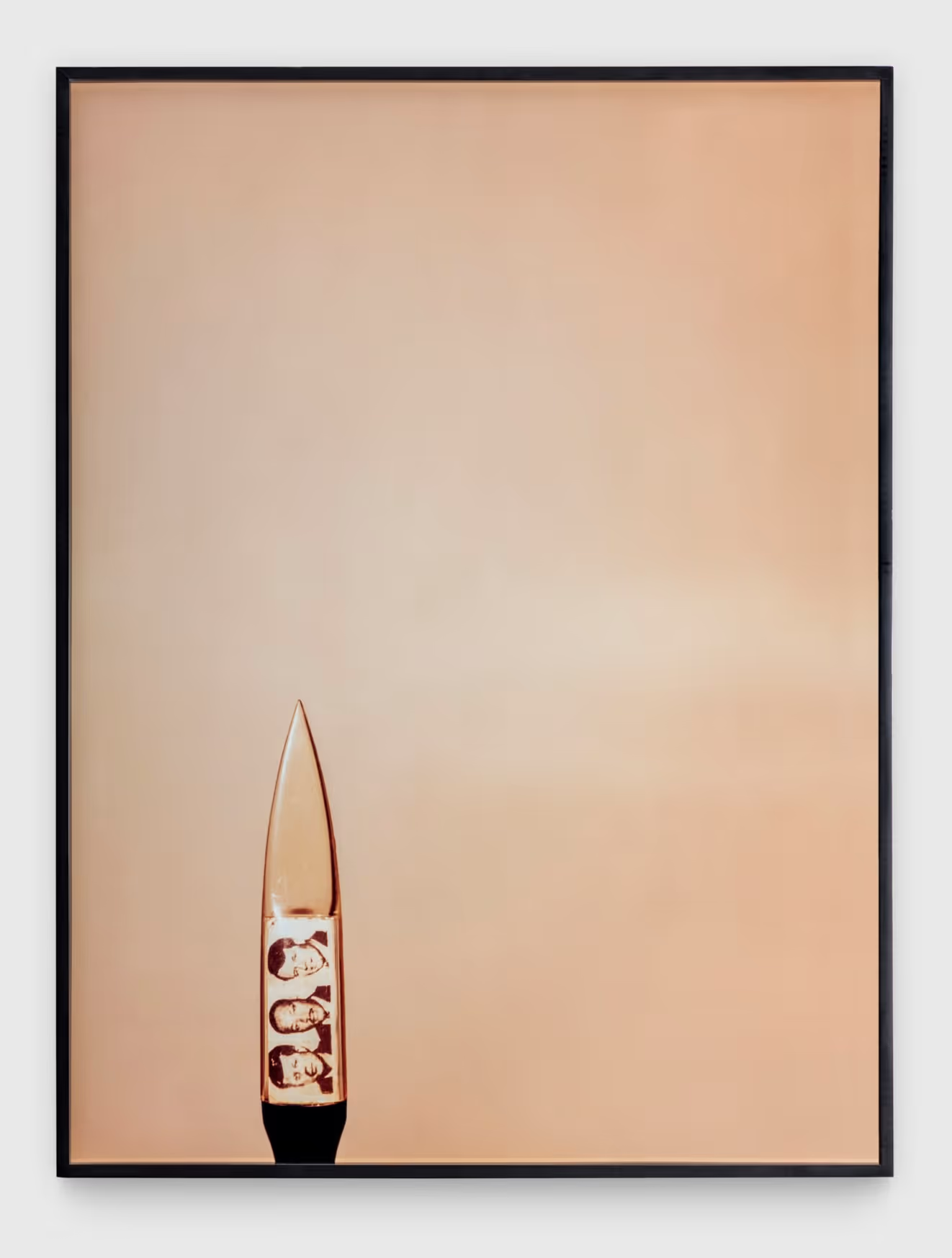
Obama’s Letter Opener
Kerry James Marshall is one of the most influential American artists of his generation, acclaimed for a practice that reimagines Western art history by centering the Black figure. Through painting, drawing, installation, and public art, Marshall interrogates the canon—from Renaissance portraiture to modernist abstraction—foregrounding themes of race, history, beauty, and everyday Black life. His work responds to what he calls “the lack in the image bank,” addressing the historic omission of Black subjects in Western art.
Born in Birmingham, Alabama at the dawn of the Civil Rights movement and raised in Los Angeles’s Watts neighborhood, Marshall’s art has long been shaped by his personal experience of American racial history. His Souvenir series (1997–98) memorializes civil rights leaders and cultural icons, while his monumental School of Beauty, School of Culture (2012) pays homage to the richness of contemporary Black life through the language of Old Master painting. His public commission Now and Forever (2023), installed at the National Cathedral in Washington, D.C., replaced Robert E. Lee–era stained glass with imagery of peaceful protest, further extending his dialogue between history, politics, and representation.
Marshall received his BFA from the Otis Art Institute (1978) and taught for many years at the University of Illinois at Chicago. His work has been recognized with a MacArthur Fellowship (1997) and inclusion in the Time 100 list (2017). He has exhibited internationally in major biennials, including Venice (2003, 2015), Documenta (1997, 2007), and the Carnegie International (1999, 2018). His 2016–17 retrospective, Mastry, organized by the Museum of Contemporary Art Chicago, traveled to The Met and MOCA Los Angeles, cementing his reputation as a transformative force in contemporary painting.
His works are held in the collections of leading institutions worldwide, including The Metropolitan Museum of Art, The Museum of Modern Art, The Whitney Museum of American Art, Tate Modern, the National Gallery of Art, the Art Institute of Chicago, and the Studio Museum in Harlem.