The Collection

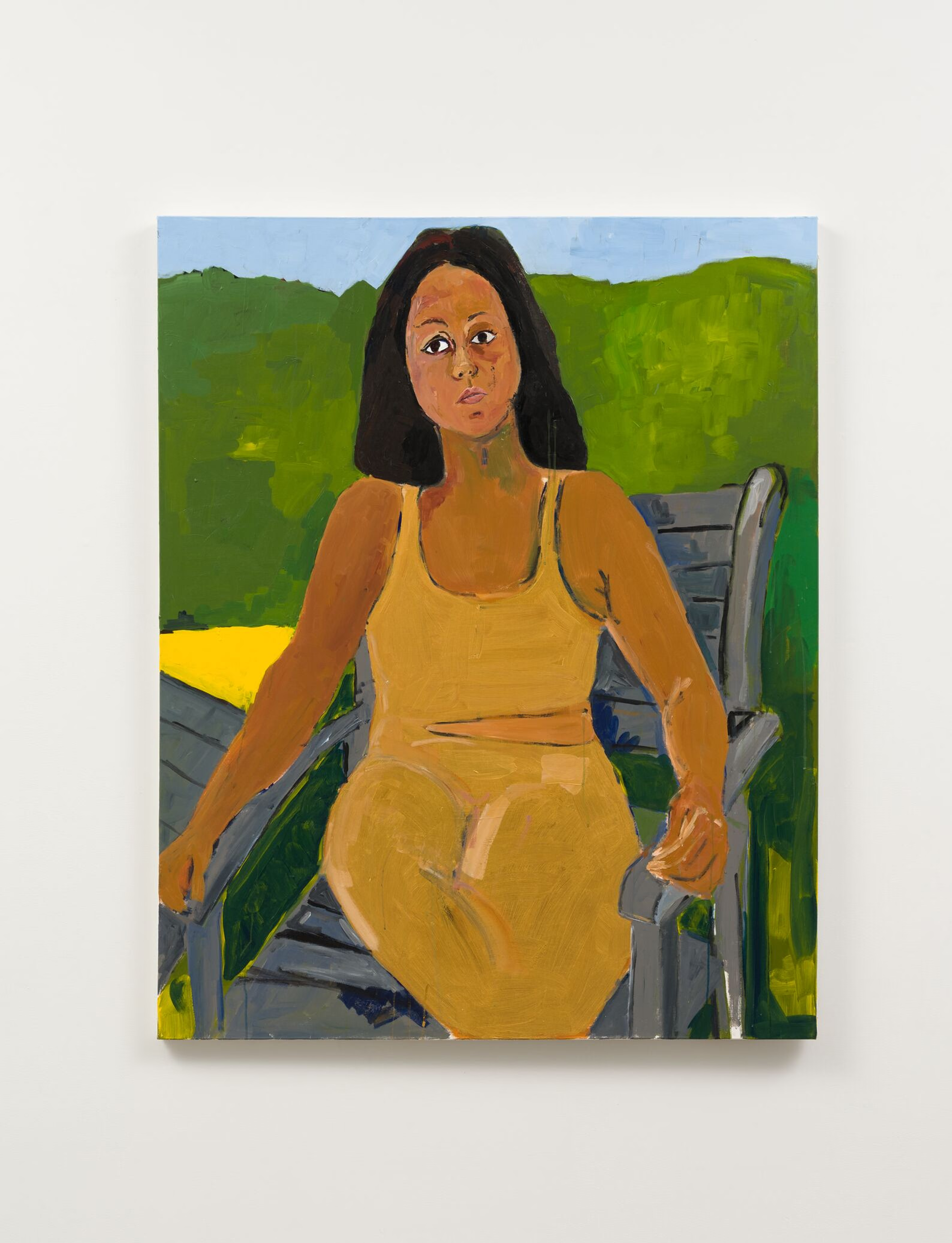
A surprised guest

Henry Taylor

A surprised guest

Acrylic on linen
44.8
in.
x
63.3
in.
x
1.3
in.

The largest work in the group, this vivid reclining figure is set against a striking red ground and demonstrates Henry’s gift for combining bold color with an almost cinematic sense of atmosphere. It’s an especially strong composition that brings forward the artist’s interest in narrative and psychological tension.

Henry Taylor is an American painter and multidisciplinary artist whose vividly colored, loosely rendered works probe the complexities of Black life in the United States. Best known for his acrylic paintings, but also working in sculpture and installation, Taylor paints what he calls “landscapes” of the world around him—portraits of family, friends, neighbors, psychiatric patients, strangers, historical and cultural figures, athletes, and celebrities—attuned to the social forces that shape their lives. His practice resists the narrow label of portraiture, instead offering holistic visual biographies that merge individual presence with broader narratives of power, inequality, community, and endurance.

Raised in Oxnard, California, as the youngest of eight siblings, Taylor was first exposed to painting through his father, a commercial painter employed by the U.S. government and Navy. He studied at Oxnard College, where artist and educator James Jarvaise became a formative mentor, and later at the California Institute of the Arts, earning his BFA in 1995. For a decade, Taylor worked as a psychiatric technician at Camarillo State Mental Hospital, an experience that deeply informed his empathetic approach to representation as he began painting patients and coworkers. This commitment to human connection underlies his “hunting and gathering” of subjects from memory, live sittings, personal snapshots, archival photographs, and news images.

Taylor’s works are characterized by gestural brushwork, saturated planes of color, and a fluid, improvisational handling of paint on both canvas and found supports—cigarette packs, detergent boxes, furniture, bottles, and other discarded objects that he sometimes assembles into totemic sculptures. His canvases have been compared to the traditions of Jacob Lawrence, Romare Bearden, and Alice Neel, while maintaining a distinctly contemporary visual language that can move from tender intimacy to pointed social critique. Works such as The Times Ain’t A Changing, Fast Enough! respond directly to police violence and racial injustice, while other series revisit historical structures of segregation, as in his paintings addressing the Masters Golf Tournament and Black caddies.

Over the past several decades, Taylor has exhibited widely in the United States and internationally, with solo presentations at institutions including MoMA PS1, The Studio Museum in Harlem, and, more recently, Henry Taylor: B Side at the Whitney Museum of American Art (2023), which traveled to the Museum of Contemporary Art, Los Angeles. In 2023, The Fabric Workshop and Museum, Philadelphia, presented Nothing Change, and Hauser & Wirth inaugurated its Paris space with his exhibition From Sugar to Shit. In 2024, Hauser & Wirth New York presented No Title, and the Schinkel Pavillon, Berlin, mounted You Me, a two-person show with Jill Mulleady. His work has also appeared in the Whitney Biennial (2017) and the 58th Venice Biennale (2019).

Taylor’s paintings and sculptures are held in major public collections, including the Museum of Modern Art, New York; the Metropolitan Museum of Art; the Whitney Museum of American Art; the Studio Museum in Harlem; the Hammer Museum and the Museum of Contemporary Art, Los Angeles; the Institute of Contemporary Art, Boston; the San Francisco Museum of Modern Art; the Carnegie Museum of Art; Pérez Art Museum Miami; and the Bourse de Commerce–Pinault Collection and Fondation Louis Vuitton in Paris, among others. He is the recipient of the Robert De Niro, Sr. Prize for painting (2018), has been honored by institutions such as CalArts and REDCAT, and in 2024 was elected to the Department of Art of the American Academy of Arts and Letters.

See the artist +

More By Henry Taylor