Artists
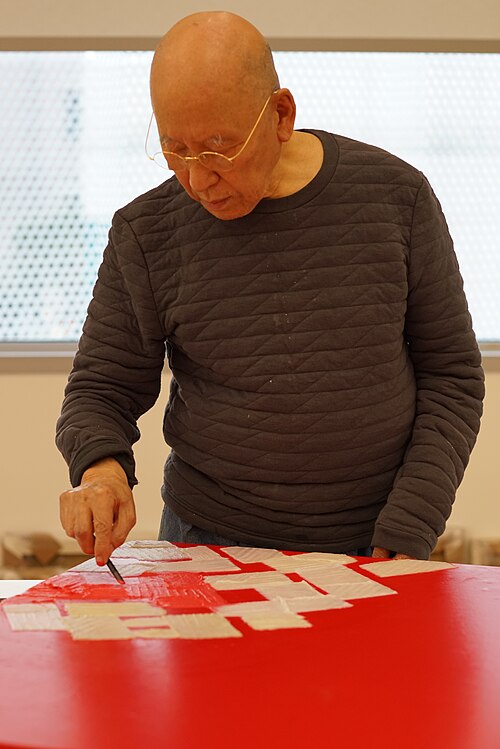
Park Seo-Bo
Yecheon, South Korea, 1931–2023
Park Seo-bo (born Park Jae-hong) was a South Korean painter widely credited as the father of the Dansaekhwa movement. Born in 1931 in Yecheon, in what was then Japanese-occupied Korea, he enrolled at Hongik University to study Korean painting, but his studies were interrupted by the Korean War, during which he survived conscription, the death of his father, and a long evacuation on foot. He graduated in 1955 after switching to Western painting, and in the same year changed his name to Park Seo-bo to evade the military draft, remaining a fugitive from conscription until his legal case was resolved in 1961.
Park became a central figure in the Korean Art Informel movement of the late 1950s as a member of the Contemporary Artists Association, and later traveled to Paris in 1961 as Korea's representative to the UNESCO International Young Painters Exhibition. In 1967, after watching his young son repeatedly write and erase a word on a gridded sheet of paper, Park began developing his signature "Écriture" series — canvases built from repeated, meditative pencil lines drawn into wet paint, and later incorporating hanji, traditional Korean mulberry-bark paper. Deliberately withholding the series from view for years, Park did not exhibit "Écriture" publicly until 1973. The work, emphasizing process and material over predetermined intention, became foundational to Dansaekhwa, the movement of Korean monochrome painting that emerged from a landmark 1975 group exhibition in which Park's work was featured alongside four other artists.
Beyond his own studio practice, Park played an outsized role in shaping contemporary Korean art institutionally — teaching and later serving as dean at Hongik University, leading the Korean Fine Arts Association's International Division, and advocating for Korean representation at international biennials in Paris, São Paulo, and Venice. He founded the Seo-bo Art and Cultural Foundation in 1994. Park's work has been exhibited at the Solomon R. Guggenheim Museum, the Museum of Fine Arts, Boston, Tate Liverpool, the Brooklyn Museum, and the National Museum of Modern and Contemporary Art, Korea, which hosted two major retrospectives of his work, in 1991 and 2019. He is held in the permanent collections of the Centre Pompidou, the Solomon R. Guggenheim Museum, the Hirshhorn Museum and Sculpture Garden, Tate, and M+, Hong Kong, among others. Park died of lung cancer in 2023 at the age of 91.

