Artists
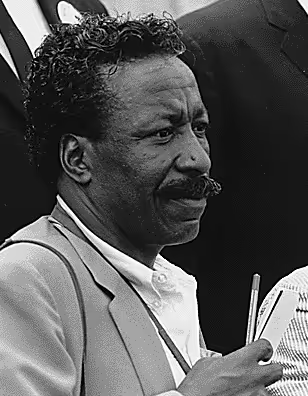
Gordon Parks
Fort Scott, KS, United States, 1912-2006
Gordon Roger Alexander Buchanan Parks was a groundbreaking American photographer, filmmaker, composer, author, and poet whose work profoundly shaped 20th-century visual culture. Born into poverty and segregation in Fort Scott, Kansas, Parks rose to prominence as one of the most important chroniclers of American life, focusing on themes of race, social justice, poverty, and the African American experience.
Parks discovered photography as a young man and began his career in the early 1940s, first shooting fashion for a department store in St. Paul, Minnesota. He later established a portrait studio at Chicago’s South Side Community Art Center, where his talent quickly drew recognition. In 1942, he won a Julius Rosenwald Fellowship that led to work with the Farm Security Administration (FSA) in Washington, D.C., and subsequently the Office of War Information (OWI). By the mid-1940s, he was freelancing for publications such as Ebony and Glamour.
In 1948, Parks became the first African American staff photographer at Life magazine, where over two decades he produced some of his most iconic photo essays, documenting subjects ranging from poverty in Harlem to the civil rights movement and global political figures. His photographs combined documentary power with a deep humanism, earning him a reputation as one of the foremost visual storytellers of his time.
Beyond photography, Parks broke barriers in film as one of the first Black American directors in Hollywood. His semiautobiographical feature The Learning Tree (1969) was the first film by an African American director to be financed and distributed by a major Hollywood studio and is preserved in the National Film Registry. He later directed the influential film Shaft (1971) and its sequel, helping define the emerging “blaxploitation” genre.
Until his death in 2006, Parks remained active as a photographer, writer, and composer, leaving behind a legacy of work that continues to influence generations of artists, filmmakers, and activists.
