Artists
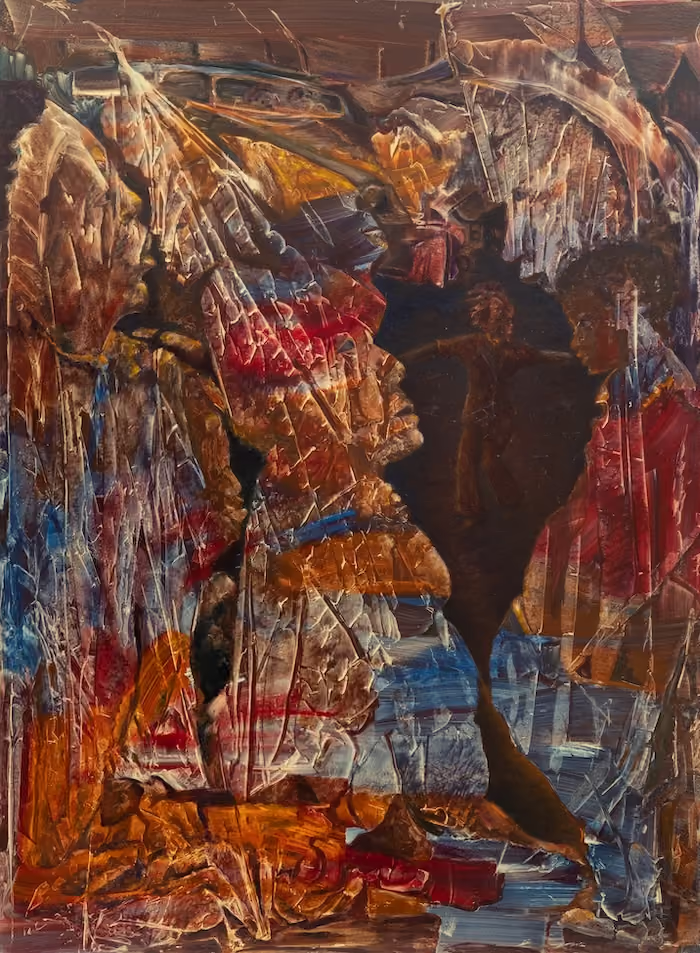
Abraham Lincoln Walker
Henderson, KY, United States, 1921-1993
Abraham Lincoln Walker was a self-taught painter born in 1921 in Henderson, Kentucky. He moved to East St. Louis, Illinois, as a child and lived there for the rest of his life. A house painter by trade, he began by imitating painting styles and making reproductions to learn palette and composition, and he leaned toward representational depictions of his neighborhood. His work was shaped by his lifelong spiritual beliefs, and at one point he became an ordained minister in the Church of God in Christ. It was also shaped by life in a once-thriving industrial city strained by economic and racial tensions, including the 1968 race riots.
Much of Walker’s work from the late 1960s and early 1970s features elongated, masked figures in desolate landscapes. From the 1970s onward, his figures became fragmented and distorted, entangled in a visionary, otherworldly space of faces, limbs, and fibrous, living forms. By the 1980s he was applying paint with pieces of wood and plastic, scraping it away with a palette knife, and using his own versions of frottage and decalcomania. He increasingly turned to celestial space, layering overlapping fields of color.
Walker took part in local exhibitions during his lifetime, including at Southern Illinois University Edwardsville and Washington State University’s Batelle Institute in Seattle (1974), but remained largely unknown beyond them. Andrew Edlin Gallery reintroduced his work at the 2024 ADAA Art Show at the Park Avenue Armory, followed by his first solo exhibition at the gallery in 2025. His work is in the collections of the High Museum of Art, the Nelson-Atkins Museum of Art, and the Speed Art Museum. A solo exhibition, Abraham Lincoln Walker: After World, 1980-1991, opens at David Kordansky Gallery, Los Angeles, on November 13, 2026. Walker died in East St. Louis in 1993.